
The Rhisotope Project at Wits is entering a new testing phase with the insertion of radioisotopes into 20 live rhinoceros. After three years of meticulous and dedicated hard work, the Rhisotope Project at Wits University has successfully inserted low doses of radioisotopes into 20 live rhinoceros. In this final phase of the research project, Professor James Larkin from the University of the Witwatersrand’s Radiation and Health Physics Unit (RHPU) in collaboration with a team of experts who are leaders in the world of rhino conservation and veterinary work, will closely monitor the health and vital statistics of the rhinos over a period of six months, in order to determine the viability of this approach.
 How It Works
The Rhisotope Project’s intention is to use nuclear technology in the form of small, measured quantities of radioisotopes and to insert these into the horns of rhinoceros, which can be picked up by radiation detection portal monitors at international borders, including at harbours, airports, and land-crossings. These radioisotopes will provide an affordable, safe, and easily applicable method to create long-lasting and detectable horn markers that cause no harm to the animals and environment. At a later stage, the work will expand to elephants, pangolins, and other fauna and flora.
The Strategy
Being pioneered in the UNESCO Waterberg Biosphere Reserve, the Project aims to benefit from existing, sophisticated multi-billion-dollar nuclear security infrastructure that already exists throughout the world. Over 11,000 radiation detection portal monitors are installed at airports, harbours, and other ports of entry, including thousands of trained personnel equipped with radiation detectors, all of which can detect the smallest radioactive particles. In contrast to this, the infrastructure and number of trained officials to detect wildlife trafficking at ports of entry internationally is extremely limited.
The Crisis
“Every 20 hours in South Africa a rhino dies for its horn. These poached horns are then trafficked across the world and used for traditional medicines, or as status symbols. This has led to their horns currently being the most valuable false commodity in the black-market trade, with a higher value even than gold, platinum, diamonds, and cocaine. Sadly, rhino horns play a large role in funding a wide variety of criminal activities globally,” says Professor James Larkin.

The Procedure
Starting on Monday, 24 June 2024, Professor Larkin and his team carefully sedated the 20 rhinos and drilled a small hole into each of their horns to insert the non-toxic radioisotopes. The rhinos were then released under the care of a highly qualified crew that will monitor the animals on a 24-hour basis for the next six months. Each insertion was closely monitored by expert veterinarians and extreme care was taken to prevent any harm to the animals.
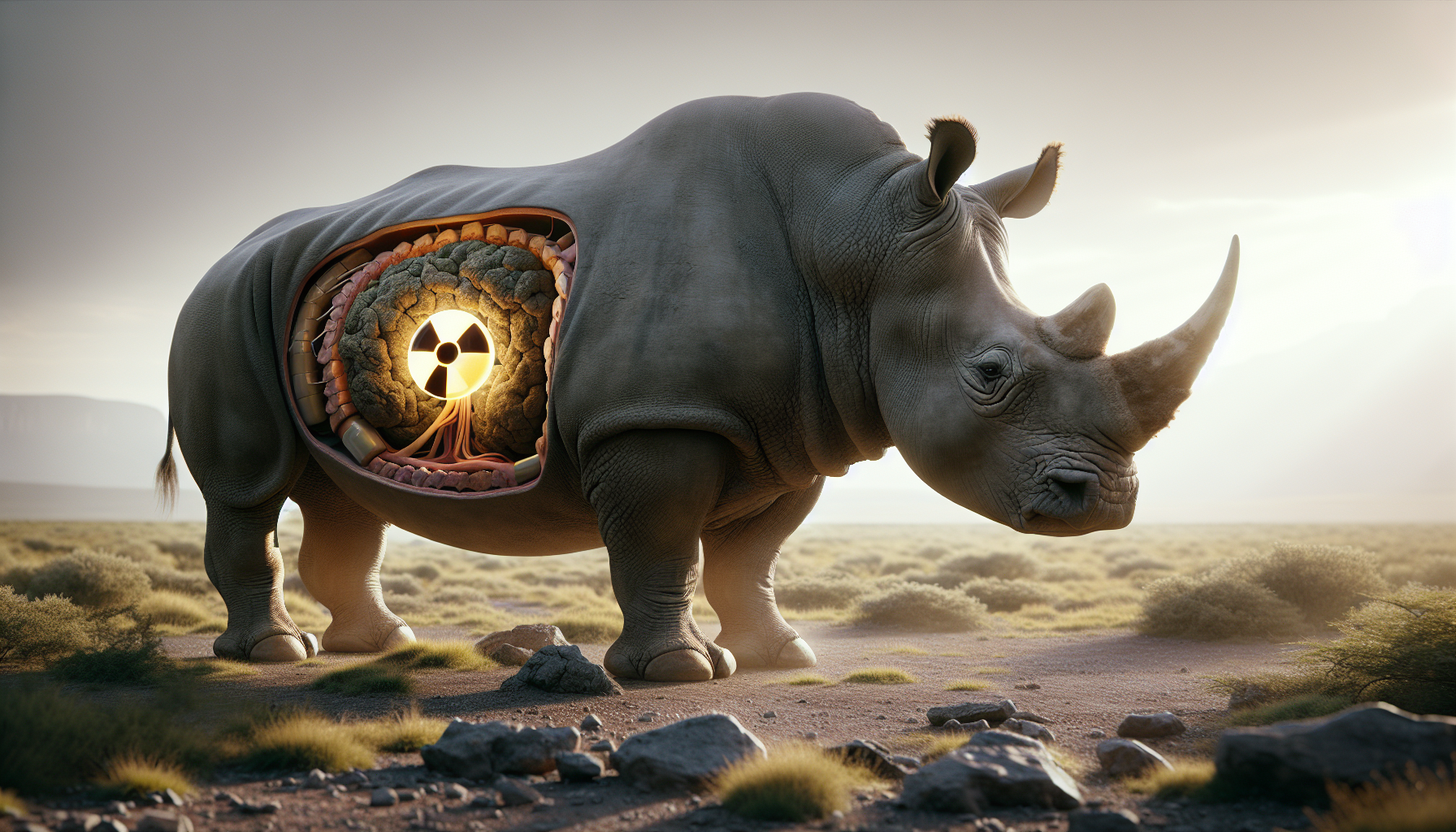
Description: A rhino after being treated with radioisotopes under the Rhisotope Project.
Impact
The development and application of the Rhisotope Project nuclear technology has the capacity to help deter poaching, increase the detection capabilities of smuggled horns, increase prosecution success, reveal smuggling routes, and deter end-user markets. Rhino poaching reached crisis levels since 2008, where close to 10,000 rhinos were lost to poaching in South Africa, with wildlife trafficking being the third biggest organised crime globally.
Cross-disciplinary Research
Professor Lynn Morris, the Deputy Vice-Chancellor: Research and Innovation at Wits University, highlights, “This is an example of how cross-disciplinary research and innovation makes a real difference. This novel approach pioneered by Prof. Larkin and his colleagues has the potential to eradicate the threat of extinction of our unique wildlife species, especially in South Africa and on the continent.” This is one of many projects at Wits that demonstrates research with impact, addressing some of the local and global challenges of the 21st Century.
Future Benefits
The Rhisotope Project at Wits was set up by a small team of likeminded individuals as a South African-based conservation initiative in January 2021 with the intention of becoming a global leader in harnessing nuclear technology to protect threatened and endangered species of fauna and flora, as well as communities of people. Aside from developing a solution to combat the illicit trade and trafficking of wildlife products, the Rhisotope Project seeks to provide education and social upliftment to empower people and local communities. A special focus is aimed at uplifting the girls and women of rural communities, who are often the backbone of these communities in the remote areas where endangered species are found.
Remember these 3 key ideas for your startup:
- Innovative Applications: The Rhisotope Project demonstrates how cutting-edge technology can be repurposed for conservation efforts. Startups should consider how innovative solutions like free productivity software can be leveraged for complex problems.
- Using Existing Infrastructure: Leveraging established, sophisticated infrastructure—like the nuclear security networks used in this project—can be a more cost-effective strategy. Startups should consider how they can integrate their initiatives with existing systems for broader impact.
- Community Involvement: The project's emphasis on social upliftment shows that holistic approaches are essential. For your startup, consider not just the technological aspect but also how your work can benefit and involve the community and end-users.
For more details, see the original source.