
We want to talk about Abstract Machine knitting, a well-established fabrication technique for complex soft objects. Both companies and researchers have developed tools for generating machine knitting patterns. However, existing representations for machine-knitted objects are incomplete, meaning they do not cover the complete domain of machine-knittable objects. Additionally, they are often overly specific and do not account for symmetries and equivalences among knitting instruction sequences. This makes it difficult to define correctness in machine knitting, let alone verify the correctness of a given program or program transformation.
The major contribution of this work is a formal semantics for knitout, a low-level Domain Specific Language for knitting machines. This is accomplished by using what we call the fenced tangle, which extends concepts from knot theory to provide a mathematical definition of knitting program equivalence that matches the intuition behind knit objects. Finally, using this formal representation, we prove the correctness of a sequence of rewrite rules and demonstrate how these rules can form the foundation for higher-level tasks like compiling a program for a specific machine and optimizing for time/reliability. This ensures the generated knit object is consistent with our proposed semantics.
By establishing formal definitions of correctness, this work provides a strong foundation for compiling and optimizing knit programs.
 Summary
Abstract Machine Knitting is an established technique used to create complex soft objects. Various companies and researchers have historically developed tools to generate knitting patterns for these machines. Despite these advancements, challenges persist due to the limitations in the current representations of machine-knitted objects. These representations fail to capture the complete spectrum of knittable objects, and they often lack consideration for symmetries and equivalences among knitting instruction sequences. As a result, it is challenging to define and verify the correctness of knitting programs or program transformations.
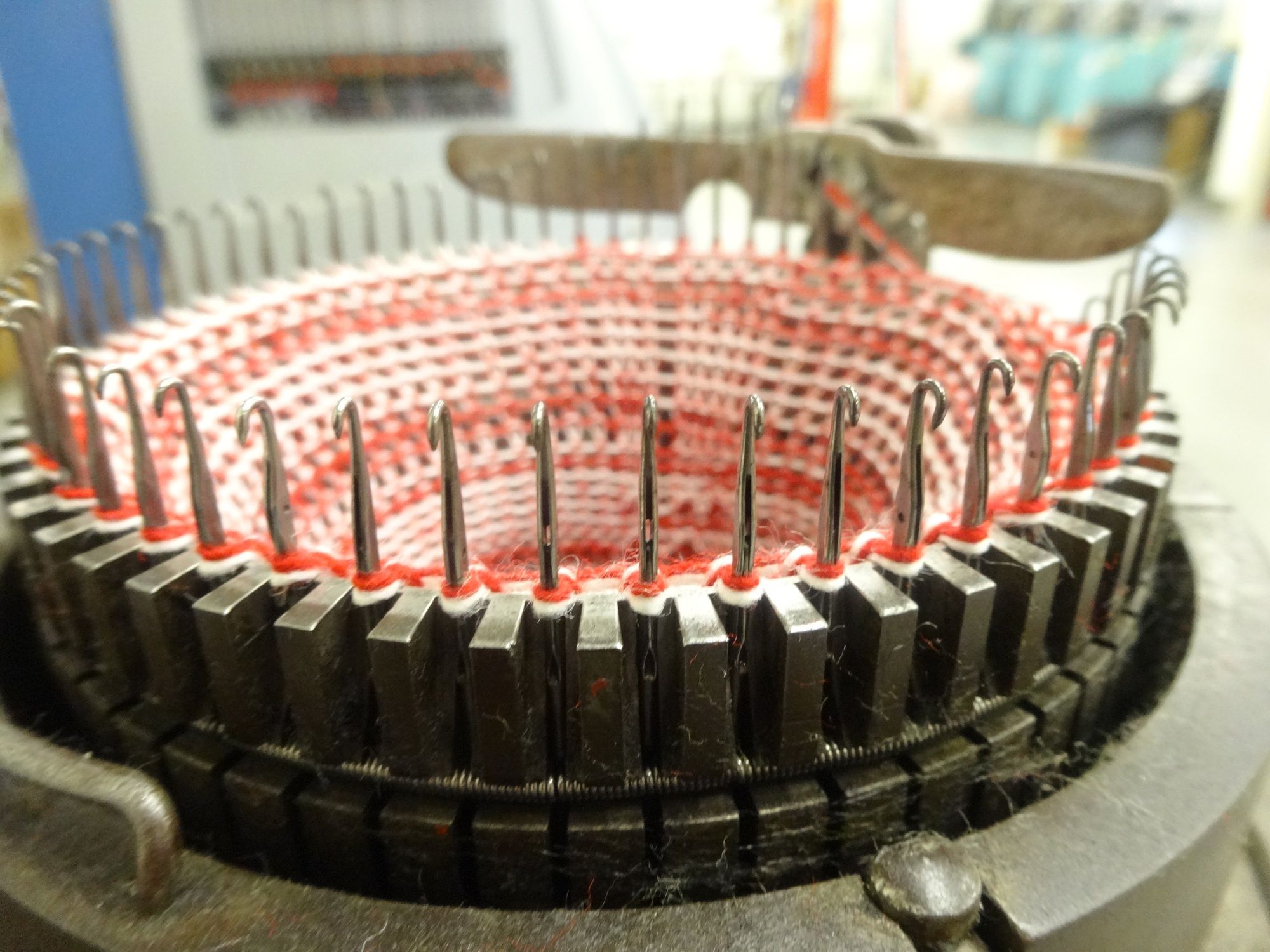
Image Description: Close-up view of a knitting machine generating a complex pattern.
The major contribution of this study introduces a formal semantics for knitout, a low-level Domain Specific Language designed for knitting machines. The key innovation here is the usage of what is known as the fenced tangle, which extends concepts from knot theory. This approach allows for a mathematical definition of program equivalence, aligning with the inherent qualities of knitted objects.
An important part of the study involves proving the correctness of a series of rewrite rules. These rules serve as a robust foundation for higher-level programming tasks, such as a machine-specific compilation and optimization in terms of time and reliability. Crucially, the redefined semantics ensure that irrespective of these optimizations, the generated knit object remains consistent with the original design.
Establishing formal definitions of correctness in this context is crucial. It provides a robust framework for compiling and optimizing knitting programs, ensuring that the final output remains both accurate and efficient. This foundational work paves the way for diverse improvements and innovations in the machine knitting sector.
For more details, see the original source.

Remember these 3 key ideas for your startup:
- Embrace Formal Semantics for Accuracy: By adopting formal semantics such as those used for knitout, startups can ensure the correctness and consistency of their knitting programs. This is paramount for delivering high-quality, reliable products while maintaining efficiency in machine operations.
- Optimize with Rewrite Rules: Utilize a sequence of rewrite rules to optimize your machine knitting processes. This will not only save time but also enhance the reliability of your manufacturing workflow, ensuring that the final product matches the original design specifications under the proposed formal semantics.
- Innovate with Mathematical Equivalence: Leverage the concept of the fenced tangle and knot theory to explore new possibilities in designing knitting patterns. These advanced mathematical techniques can help you define programming equivalences that maintain the integrity and symmetry of knitted objects, fostering innovation and precision in your designs.
Edworking is the best and smartest decision for SMEs and startups to be more productive. Edworking is a FREE superapp of productivity that includes all you need for work powered by AI in the same superapp, connecting Task Management, Docs, Chat, Videocall, and File Management. Save money today by not paying for Slack, Trello, Dropbox, Zoom, and Notion.