Today in Edworking News we want to talk about 2D Rigid Body Collision Resolution.
From Mario bouncing off a Goomba to two cars bumping into each other in a racing game, dealing with collisions is such an integral part of most video games that we often take it for granted. In this series of blog posts, I want to show you what actually goes on behind the scenes in a physics simulation like the one above.
While we're going to look at this through the lens of video games, this post is really about the actual math and physics of collisions. Video games are just a nice way to contextualize these concepts and help make things a little less abstract.
While these articles will involve a fair bit of math, please don't be discouraged by that if you don't consider yourself to be a "math person". I think this kind of thinking is harmful and actively prevents you from engaging with topics that you might actually enjoy! Many times, it's the math notation that makes things look more complicated than they actually are because it's so information-dense and unfamiliar.
 Rigid Bodies
The specific kind of physics simulation we are going to cover is called rigid body physics. A rigid body is a body that does not deform when subjected to forces. This is an idealized model because true rigid bodies do not exist in the real world; everything deforms on the molecular level even if this deformation is not visible to the naked eye. For most physics simulations, trying to simulate this level of detail is not only extremely difficult and computationally expensive, it's also unnecessary.
Collision Detection vs. Collision Resolution
In a video game engine, dealing with collisions can be broken down into two distinct phases: collision detection and collision resolution. Collision detection is about determining which bodies in our scene are colliding. This usually involves a bunch of geometry to check if two shapes are intersecting or overlapping. Collision resolution is the process of figuring out what needs to happen to two colliding bodies based on their current movement directions, speeds, materials, and other factors.
Defining the Problem
Most games run in a big loop. To move items on the screen, the game engine continually calculates positions of various objects. Velocity is a vector quantity, meaning it has both magnitude and direction. We can represent an object's current velocity with an arrow, where the length of the arrow represents the object's speed, and the direction the arrow points represents its travel direction.

What is a Collision?
We learned that two bodies are said to be colliding if they are moving towards each other and their geometries overlap. However, understanding the exact mechanics of a collision involves both velocity and displacement calculations.
Surface Normals
The normal direction of a surface is always perpendicular to the surface. It is the direction that points directly away from the surface. Normal directions are represented with a normalized vector, a vector with length 1.
The Dot Product
To calculate how much of one vector is pointing in the same direction as another, we can use the dot product of the two vectors.
In English, the dot product of two vectors is the length of the scalar projection of one vector onto the other, multiplied by the length of the vector we’re projecting onto.
Using the concepts of dot products and surface normals, we can analyze the scenarios under which objects interact during collisions.
Conclusion
If you made it to this point, pat yourself on the back! We now have a formal definition of what a collision is, as well as the set of equations we are trying to solve when resolving collisions. In the next post, we'll dive deeper into the actual physics behind collisions.
Edworking is the best and smartest decision for SMEs and startups to be more productive. Edworking is a FREE superapp of productivity that includes all you need for work powered by AI in the same superapp, connecting Task Management, Docs, Chat, Videocall, and File Management. Save money today by not paying for Slack, Trello, Dropbox, Zoom, and Notion.
Remember these 3 key ideas for your startup:
- Optimization is Key: Efficiently dealing with collisions in game engines involves breaking tasks into manageable sub-tasks, like collision detection and resolution, which can also be applied to other business processes. Understanding these processes can be essential for startup success.
- Simplify Complexity: Just as rigid body approximation simplifies real physical interactions, simplifying complex business processes without compromising realism can save computational and operational resources. Learn how to streamline your processes for better efficiency.
- Leverage Tools Efficiently: Mathematics and physics are essential for developing efficient gaming engines. Similarly, utilizing productivity tools like Edworking can make processes streamlined and more efficient.
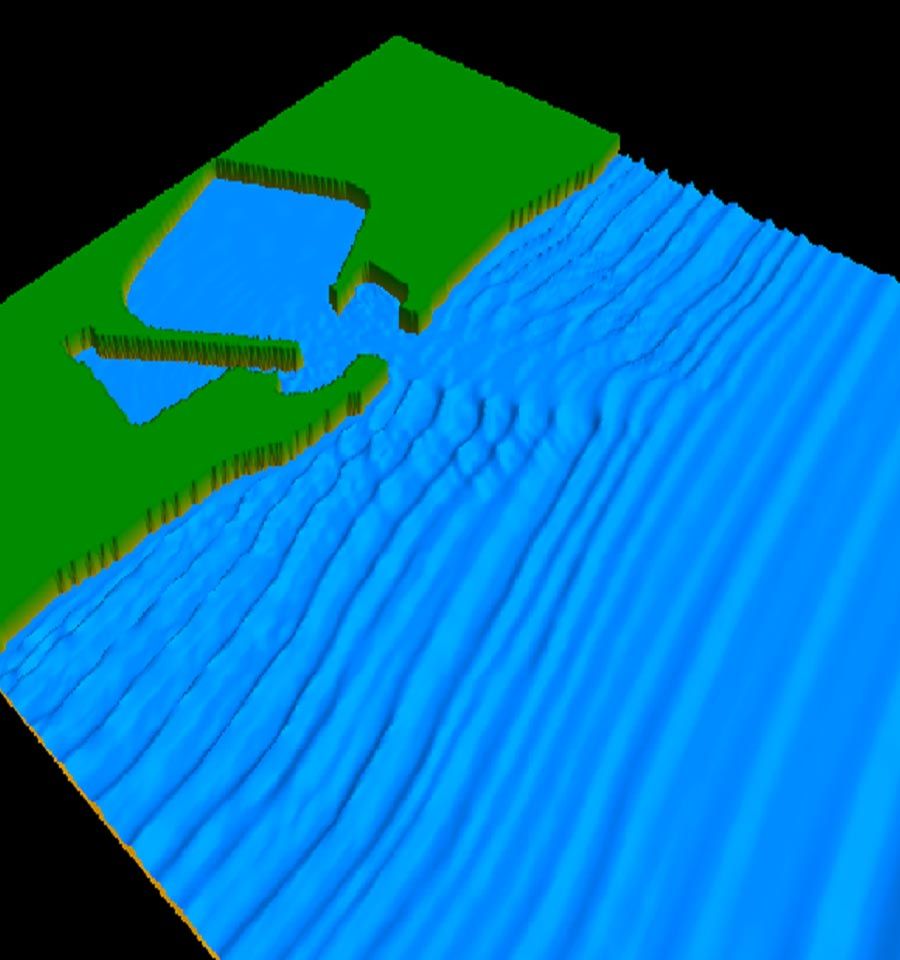
- Caption: Physics simulations are simplified to make real-world calculations feasible.
Feel free to discuss this article and reach out for more information!
Twitter: @ksassnowski
For more details, see the original source.