
 Download Mobile App
The project management field guide
Project Management. Put It Into Practice.
Find the guide, tool or template for the work in front of you. Leave with a next step your team can act on.
What brings you here?
From reading to doing
Start with something you can use.
Make a plan, choose a priority or review your tools. Each resource gives you a concrete place to start.
Start a project
Define the outcome, estimate the work and give the first deliverables an owner.
Preview the templateUnblock delivery
Check project health, make risks visible and agree a recovery action.
Preview the templateAlign the team
Connect responsibilities, capacity and the updates your team actually needs.
Preview the templateThe project management field guide
Find your next useful resource
Search the whole hub or narrow it to one topic. Every resource opens on its own page.
67 resources
- Templates
Project Kickoff Checklist
Use this project kickoff checklist to align goals, scope, owners, risks, decisions, and next steps before delivery starts.
Open resource - Tools & Workflows
Project Health Check
Run a project health check for scope, schedule, workload, risk, communication, and quality, then turn weak signals into team actions.
Open resource - Project Planning & Execution
Planning Basics
Open resource - Tools & Workflows
Team Capacity Calculator
Estimate team capacity, focus time, support load, buffer, and planned work before committing to a sprint or project plan in Edworking.
Open resource - Templates
RAID Log Template
Use this RAID log template to track risks, assumptions, issues, dependencies, owners, actions, and review cadence in one shared workflow.
Open resource - Popular PM Methodologies
Agile vs Waterfall
The ultimate comparison. We analyze cost, risk, and flexibility to help you choose between linear and iterative project management.
Open resource - Practice Tests
PM Fundamentals
Are you a PM pro? Test your understanding of essential tools like Work Breakdown Structures (WBS), Gantt charts, and RACI matrices.
Open resource - Professional Certifications
PMP Study Plan
Build a practical PMP study plan with weekly milestones, process-group review, mock exams, weak-area tracking, and Edworking workflow tips.
Open resource - Careers & Salary Guides
Career Paths
Map your growth. Explore job descriptions, salary jumps, and leadership requirements for every tier of the project management hierarchy.
Open resource - Project Management Fundamentals
What is Project Management?
A comprehensive definition of PM. Explore its evolution from industrial engineering to modern Agile frameworks and AI integration.
Open resource - Project Management Fundamentals
What is a Project?
Learn the two traits that define a project: temporary and unique. Discover how to distinguish project-based work from ongoing operations.
Open resource - Project Management Fundamentals
Why Use PM?
The reasoning behind implementing PM practices
Open resource - Project Management Fundamentals
Benefits of PM
Key advantages and value delivered by effective PM
Open resource - Project Management Fundamentals
Core Components
Master the 7 core project management components and connect scope, time, cost, quality, resources, risk, and communication in daily work.
Open resource - Project Management Fundamentals
Constraints
Understand the Triple Constraint. Learn how to balance quality when scope, budget, or deadlines change in a dynamic environment.
Open resource - Project Management Fundamentals
Project Lifecycle
Learn what project life cycle phases are, how they differ from the five process groups, and how to apply both to a practical website launch example.
Open resource - Project Management Fundamentals
PM Principles
A deep dive into Stewardship, Value, and Systems Thinking. Compare the 12 Principles of PMBOK 7 with the 7 Principles of PRINCE2.
Open resource - Project Management Fundamentals
PM Roles
Define who does what. A clear breakdown of the Project Sponsor, Project Manager, Steering Committee, and individual Team Member roles.
Open resource - Project Management Fundamentals
PM Tasks
Day-in-the-life of a Project Manager. Explore the balance of technical skills (budgeting) and power skills (leadership, negotiation).
Open resource - Project Management Fundamentals
Who Uses PM?
From Construction to Fintech and Healthcare, see how different industries apply PM principles to drive innovation and delivery.
Open resource - Project Management Fundamentals
When to Use PM
Do you need a Project Manager? We outline the triggers, budget, cross-functional needs, and risk, that require formal PM methodologies.
Open resource - Project Management Fundamentals
History of PM
Trace the evolution of project management. From Henry Gantt and the Polaris Missile to the rise of AI-driven Lean methodologies.
Open resource - Project Management Fundamentals
PM vs Product Management
Output vs. Outcome. We compare PM vs. PdM roles, salaries, and career trajectories to help you choose the right path.
Open resource - Popular PM Methodologies
Agile
Master the Agile mindset. Learn how iterative development and customer-centricity drive value in modern software and creative projects.
Open resource - Popular PM Methodologies
Scrum
Master Scrum. A complete guide to Sprints, Daily Stand-ups, and the roles of Scrum Master, Product Owner, and Development Team.
Open resource - Popular PM Methodologies
Kanban
Optimize flow and reduce waste. Learn to use Kanban boards and Work In Progress (WIP) limits for continuous delivery and efficiency.
Open resource - Popular PM Methodologies
Waterfall
The classic sequential approach. Learn when to use Waterfall for predictable, high-compliance projects and how to manage its 5 phases.
Open resource - Popular PM Methodologies
PRINCE2
Master the UK’s standard for PM. Learn how PRINCE2’s structure ensures continued business justification and effective governance.
Open resource - Popular PM Methodologies
Hybrid
Learn when to combine predictive planning with adaptive delivery, compare common hybrid patterns, and define clear governance and team handoffs.
Open resource - Popular PM Methodologies
Scrum vs Kanban
Find your fit. Compare Scrum's time-boxed iterations against Kanban's pull-based continuous delivery system for team efficiency.
Open resource - Project Planning & Execution
Task & Work Breakdown
Open resource - Project Planning & Execution
Resource Management
Open resource - Project Planning & Execution
Risk Management
Open resource - Project Planning & Execution
Monitoring & Delivery
Open resource - Professional Certifications
PMP
Everything you need to get PMP certified. Learn about the 24% salary premium, exam domains, and the latest application requirements.
Open resource - Professional Certifications
CAPM
Start your PM career. Learn about CAPM exam content, costs, and how it prepares you for a Project Manager role without prior experience.
Open resource - Professional Certifications
CSM
Become a ScrumMaster. Learn about the Scrum Alliance certification, workshop requirements, and how to advance to A-CSM and CSP-SM.
Open resource - Professional Certifications
PMI-ACP
Go beyond Scrum. Learn the PMI-ACP requirements for Scrum, Kanban, Lean, and XP. Compare it with the CSM certification for Agile roles.
Open resource - Professional Certifications
PRINCE2 Certification
Master the 7th edition of PRINCE2. Explore the Foundation to Practitioner pathway and the focus on sustainability and people-centricity.
Open resource - Professional Certifications
SAFe
Lead enterprise transformation. Explore SAFe framework certification, exam details, and roles like Release Train Engineer (RTE).
Open resource - Careers & Salary Guides
Salary Guide
Compare the U.S. BLS May 2025 median with PMI's latest global certification survey, with source dates and limits for responsible salary benchmarking.
Open resource - Careers & Salary Guides
Competency Matrix
Build a role-specific project management competency matrix using observable behaviors, evidence, calibrated ratings, and development actions.
Open resource - Careers & Salary Guides
Resume Optimization
Get hired faster. Learn high-impact keywords, achievement-based writing, and digital branding strategies to beat the ATS in 2026.
Open resource - Tools & Workflows
EVM Calculator
Calculate EVM metrics for PMP prep and project controls, then interpret cost, schedule, variance, and forecast signals clearly.
Open resource - Tools & Workflows
PERT Estimation
Calculate PERT expected time, standard deviation and variance from optimistic, most likely and pessimistic estimates. Compare beta and triangular methods.
Open resource - Tools & Workflows
Risk Matrix
Build a practical risk matrix with impact and probability scoring, then move mitigation into Edworking tasks for faster team follow-through.
Open resource - Tools & Workflows
Stakeholder Analysis Matrix
Map stakeholders by influence and interest, spot communication priorities, and turn stakeholder analysis into a practical project action plan.
Open resource - Tools & Workflows
Productivity Calculator
Measure efficiency and calculate the cost of context-switching. Identify workflow leaks and optimize your team's output for distributed environments.
Open resource - Tools & Workflows
Kanban vs Scrum Quiz
Take our 2-minute diagnostic assessment. Discover if Scrum, Kanban, or a Hybrid approach suits your project complexity and delivery speed.
Open resource - Tools & Workflows
PMP Process Game
Practice the 49 PMP process groups, find weak areas fast, and turn every study round into tasks, docs, and review sessions in Edworking.
Open resource - Practice Tests
Scrum Master Level 1
Open resource - Practice Tests
Scrum Master Level 2
Open resource - Practice Tests
Scrum Master Level 3
Open resource - Practice Tests
PMP Basics
Free PMP quiz covering process groups and the 12 principles of project management. Test your readiness for the global gold standard.
Open resource - Practice Tests
Agile Foundations
Validate your Agile mindset. Test your knowledge of the 4 values, 12 principles, and iterative delivery practices.
Open resource - Practice Tests
Kanban Essentials
Test your knowledge of Kanban metrics. Learn to identify bottlenecks, manage WIP limits, and optimize lead time and cycle time.
Open resource - Practice Tests
Risk Management Test
Master risk identification and response strategies. Practice questions on qualitative and quantitative risk analysis for PM certifications.
Open resource - Software & Platforms
Software & Platforms
Compare project management software for tasks, docs, chat, and calls in one workspace. Evaluate features, workflows, and team-fit before you switch.
Open resource - Templates
Startup Project Charter
Use a startup project charter template with scope, risks, milestones, and team ownership examples built for faster execution.
Open resource - Templates
Risk Register Template
Use this risk register template to identify, assess, and mitigate project risks with clear ownership and weekly review workflows.
Open resource - Templates
Project Communication Plan Template
Use this project communication plan template to align stakeholders, channels, updates, blockers, and ownership in one shared workflow.
Open resource - Templates
Decision Log Template
Use this decision log template to document project decisions, owners, rationale, and follow-up actions in one shared format.
Open resource - Templates
Project Status Report Template
Use this project status report template to align teams on progress, blockers, risks, and next actions in one concise weekly update.
Open resource - Tools & Workflows
Async handoff planner
Create an async handoff plan with owners, context, blockers, and next actions so remote project work keeps moving in Edworking.
Open resource - Tools & Workflows
Team dependency map
Build a team dependency map to spot blockers, owners, and handoffs before project work stalls, then turn risks into Edworking tasks.
Open resource - Tools & Workflows
Action item tracker
Use this action item tracker to capture meeting decisions, owners, deadlines, and follow-up tasks in one connected project workspace.
Open resource - Templates
Resource planning template
Use this resource planning template to map people, capacity, deadlines, risks, and owners before project work overloads the team.
Open resource
Go deeper into a topic
Everything you need to understand before choosing methods or tools. Core concepts, principles, and the project lifecycle.
Understand how projects are run and which approach fits best. Waterfall, Agile, Scrum, Kanban, and more.
The bridge between theory and tools. Practical guides on how to plan, execute, and deliver projects.
Practical tools, calculators, assessments, and templates. Time estimation, risk assessment, and productivity metrics.
Ready-to-use project management templates. Copy directly into Edworking Docs and customize for your team.
Test your PM knowledge with quizzes on Scrum (3 levels), PMP, Agile, Kanban, and risk management. Prepare for certifications.
PMP, CAPM, PRINCE2, PMI-ACP, CSM, and SAFe certifications. Compare costs, prerequisites, exam formats, and career impact.
Career paths from coordinator to executive, 2026 salary benchmarks, competency frameworks, and resume optimization.
Compare project management software and find the best fit for your team. Features, pricing, and detailed reviews.
The project management field guide
See the work come together
Explore tasks, decisions and files in a sample Edworking workspace.
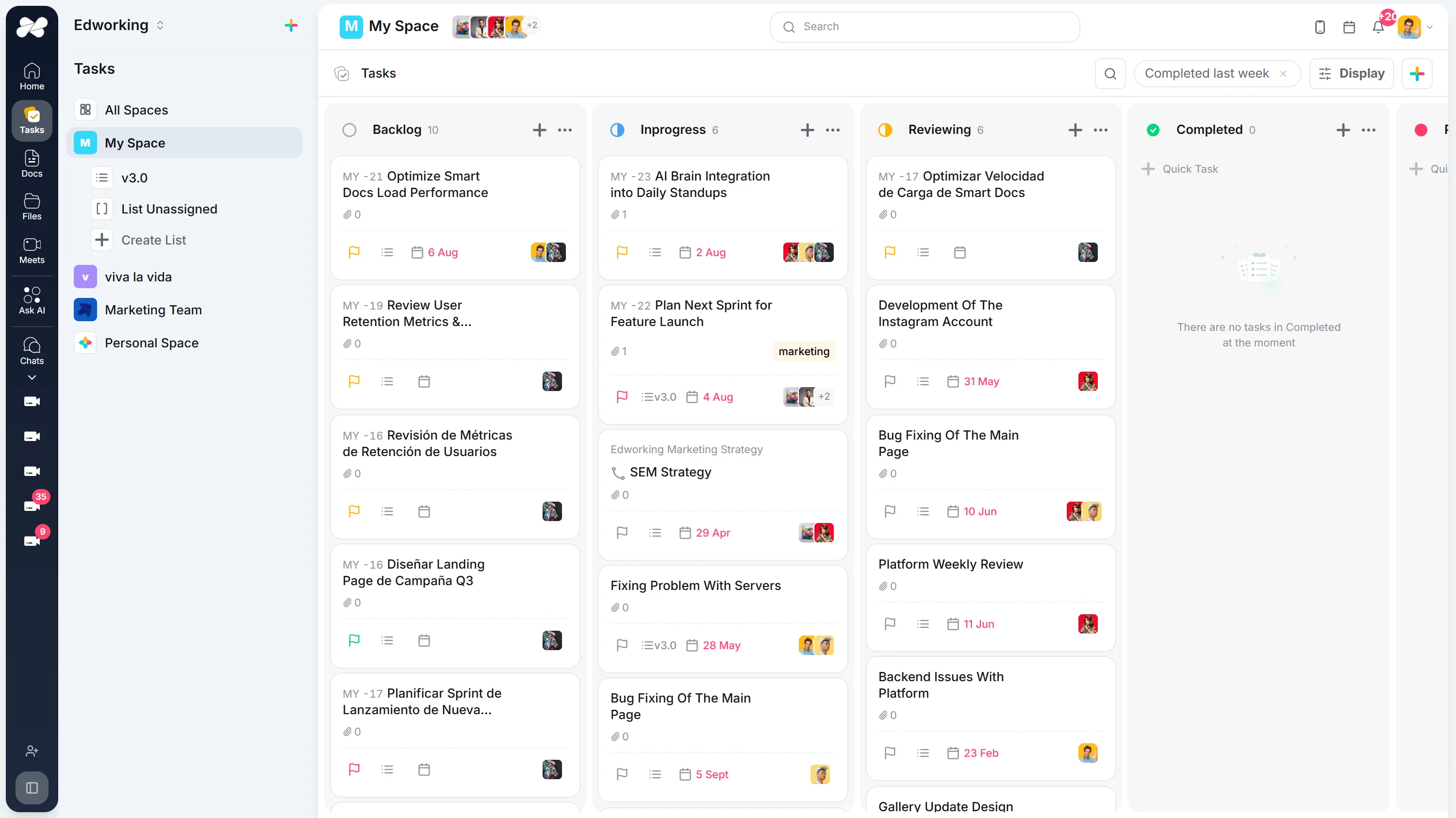
Opens the full interactive demo with an example workspace in English.
Frequently Asked Questions
A project manager focuses on the execution and delivery of a project within constraints like time, budget, and scope. A product manager focuses on the strategy, roadmap, and features of a product to meet customer needs.
It depends on your project. Waterfall is good for strict, linear projects. Agile is better for flexible, iterative projects. Scrum is great for product development, and Kanban is ideal for continuous workflows.
Not necessarily, but it is highly respected. Many companies value experience over certification, but a PMP can help you stand out and demonstrates a solid understanding of PMBOK principles.
Communication, leadership, organization, risk management, and problem-solving are essential. Being able to negotiate and manage stakeholders is also critical.
You can use techniques like bottom-up estimating (summing individual task costs), analogous estimating (using past projects), or parametric estimating (using statistical relationships). Don't forget to include overhead and contingency reserves.
Get from idea to a clear kickoff
Choose What to Put into Practice
Pick the points that fit your idea or project. We’ll create a Space with those tasks so you can put this page into practice.
- 01Choose the tasks that matter to you.
- 02Set up a Space with your selected tasks.
- 03Add owners, dates and details in Edworking.
0 tasks selected
Select at least one task to set up your Space.