
 Download Mobile App


Good ideas need a next step.
Startup Resources for Founders & Teams
Explore startup guides, tools, templates, and best practices to build, manage, and scale your startup. Everything founders need in one place.
Your next three moves
From reading to doing
Start with something you can use.
Make a plan, choose a priority or review your tools. Each resource gives you a concrete place to start.
Plan your next release
Plan your startup journey with milestones, goals, and execution timelines
Open resourceFind your next priority
Score startup ideas, features, and operational work by impact, urgency, confidence, revenue fit, and effort.
Open resourceReview your tool stack
Score how well your tasks, docs, chat, meetings, files, and AI tools work together before adding another app.
Open resourceThe founder’s library
Find what you need next
Search practical guides, tools and templates, or choose a topic to narrow things down.
50 resources
- Templates & Resources
Startup Roadmap Template
Plan your startup journey with milestones, goals, and execution timelines
Open resource - Tools
Startup Priority Scorecard
Score startup ideas, features, and operational work by impact, urgency, confidence, revenue fit, and effort.
Open resource - Startup Fundamentals
How to Start a Startup
A step-by-step guide from idea validation to launch and beyond
Open resource - Operations & Management
Weekly Team Review
A lightweight weekly operating rhythm for priorities, blockers, decisions, and follow-up work
Open resource - Tools
Runway Calculator
Find out how long your cash will last based on your burn rate
Open resource - Templates & Resources
Meeting Notes Template
Capture decisions, action items, owners, blockers, and follow-up from every startup meeting in a reusable template.
Open resource - Growth & Funding
Startup Metrics
The key metrics every startup should track, from CAC to LTV to burn rate
Open resource - Templates & Resources
Business Plan Template
Create a clear, investor-ready business plan for your startup
Open resource - Tools
Collaboration Stack Assessment
Score how well your tasks, docs, chat, meetings, files, and AI tools work together before adding another app.
Open resource - Startup Fundamentals
What is a Startup?
Understanding the definition, key traits, and what sets startups apart from traditional businesses
Open resource - Startup Fundamentals
Startup Stages
Understanding the journey from pre-seed to scale and what each stage requires
Open resource - Startup Fundamentals
Startup Team Roles
Essential positions and responsibilities in early-stage startups
Open resource - Startup Fundamentals
Startup Business Plan
What a business plan includes and when you actually need one
Open resource - Startup Fundamentals
Lean Startup vs Business Plan
Comparing modern lean approaches with traditional planning
Open resource - Startup Fundamentals
Bootstrapped vs Funded
Pros and cons of self-funding versus raising investment
Open resource - Startup Fundamentals
Startup Funding Explained
How startups raise capital and common funding sources
Open resource - Startup Fundamentals
How to Invest in Startups
A beginner's guide to startup investing
Open resource - Startup Fundamentals
Angel Investors
Who they are and how they invest in early-stage startups
Open resource - Startup Fundamentals
Venture Capital
Understanding VC firms and how they work
Open resource - Startup Fundamentals
Angel vs Venture Capital
Key differences between angel and VC funding
Open resource - Startup Fundamentals
Startup Valuation
Methods and factors that determine startup worth
Open resource - Startup Fundamentals
Unicorn Startups
What the $1B valuation milestone means
Open resource - Operations & Management
Project Management for Startups
How startups manage projects, timelines, and priorities without slowing down execution
Open resource - Operations & Management
Collaboration in Startup Teams
Improve collaboration with better communication, shared docs, and aligned workflows
Open resource - Operations & Management
Managing a Remote Startup Team
Best practices and tools for managing fully remote or hybrid startup teams
Open resource - Operations & Management
Task Management for Startups
Learn how startups manage tasks, priorities, and execution without creating process overhead
Open resource - Operations & Management
Communication in Startup Teams
How startups manage internal communication without meetings overload or message chaos
Open resource - Operations & Management
Meetings in Startups
Best practices for running efficient startup meetings without slowing teams down
Open resource - Operations & Management
Documentation in Startups
How startups use documentation to reduce meetings and scale efficiently
Open resource - Tools
Startup Valuation Calculator
Estimate your startup's value using common early-stage valuation methods
Open resource - Tools
Equity Split Calculator
Calculate a fair equity split between founders based on roles and contribution
Open resource - Tools
Burn Rate Calculator
Track and understand your monthly spending patterns
Open resource - Tools
Meeting Cost Calculator
Estimate the real cost of recurring team meetings and decide what should move async
Open resource - Tools
Dilution Calculator
See how funding rounds affect your equity ownership
Open resource - Tools
AI Workflow Readiness Assessment
Score whether your startup has the knowledge, tasks, review habits, security rules, and adoption rhythm needed before adding AI to daily work.
Open resource - Tools
Meeting Follow-Up Scorecard
Score whether your meetings produce decisions, owners, notes, and visible follow-up tasks.
Open resource - Tools
Essential Tools for Startups
A comprehensive overview of the tools startups need to operate, collaborate, and scale
Open resource - Tools
Project Management Software
Compare project management platforms designed for fast-moving startup teams
Open resource - Growth & Funding
Startup Funding Stages
From pre-seed to Series C and beyond, understand each funding stage and what investors expect
Open resource - Growth & Funding
Startup KPIs
How to set and track Key Performance Indicators at each stage of growth
Open resource - Growth & Funding
Scaling a Startup
Strategies for scaling operations, team, and product without breaking
Open resource - Templates & Resources
Essential Startup Templates
A curated collection of must-have templates for every startup founder
Open resource - Templates & Resources
Meeting Agenda Templates
Run efficient startup meetings with ready-to-use agenda templates
Open resource - Templates & Resources
Document Templates
Essential document templates for operations, hiring, and processes
Open resource - Templates & Resources
Pitch Deck Template
Create a compelling pitch deck with a proven slide-by-slide structure
Open resource - Templates & Resources
OKR Template
Set clear objectives and track progress with quarterly OKRs
Open resource - Templates & Resources
Startup Checklists
Practical checklists for launch, operations, and fundraising readiness
Open resource - Templates & Resources
Remote Onboarding Checklist
A 30-60-90 day checklist for welcoming distributed startup teammates
Open resource - Templates & Resources
Remote Workflow Checklist
Audit remote tasks, docs, chat, meetings, files, and AI habits before work scatters.
Open resource - Templates & Resources
Tool Consolidation Checklist
Audit overlapping apps and decide what a startup should replace, keep, or connect.
Open resource
Go deeper into a topic
Learn what defines a startup, how to start one, the stages of growth, and essential team roles for early-stage companies.
Best practices for managing startup operations, tasks, communication, collaboration, and remote teams efficiently.
Free interactive calculators to help founders make better decisions about valuation, equity, runway, and funding.
Understand startup funding stages, key metrics, KPIs, and strategies to scale your startup effectively.
Free startup templates, documents, roadmaps, and checklists to help founders move faster.
Startup buying guide
Choose the right startup workspace before tools multiply
Startup teams usually do not need more apps. They need one place where priorities, ownership, docs, files, chat, meetings, and AI context stay connected as the company changes.
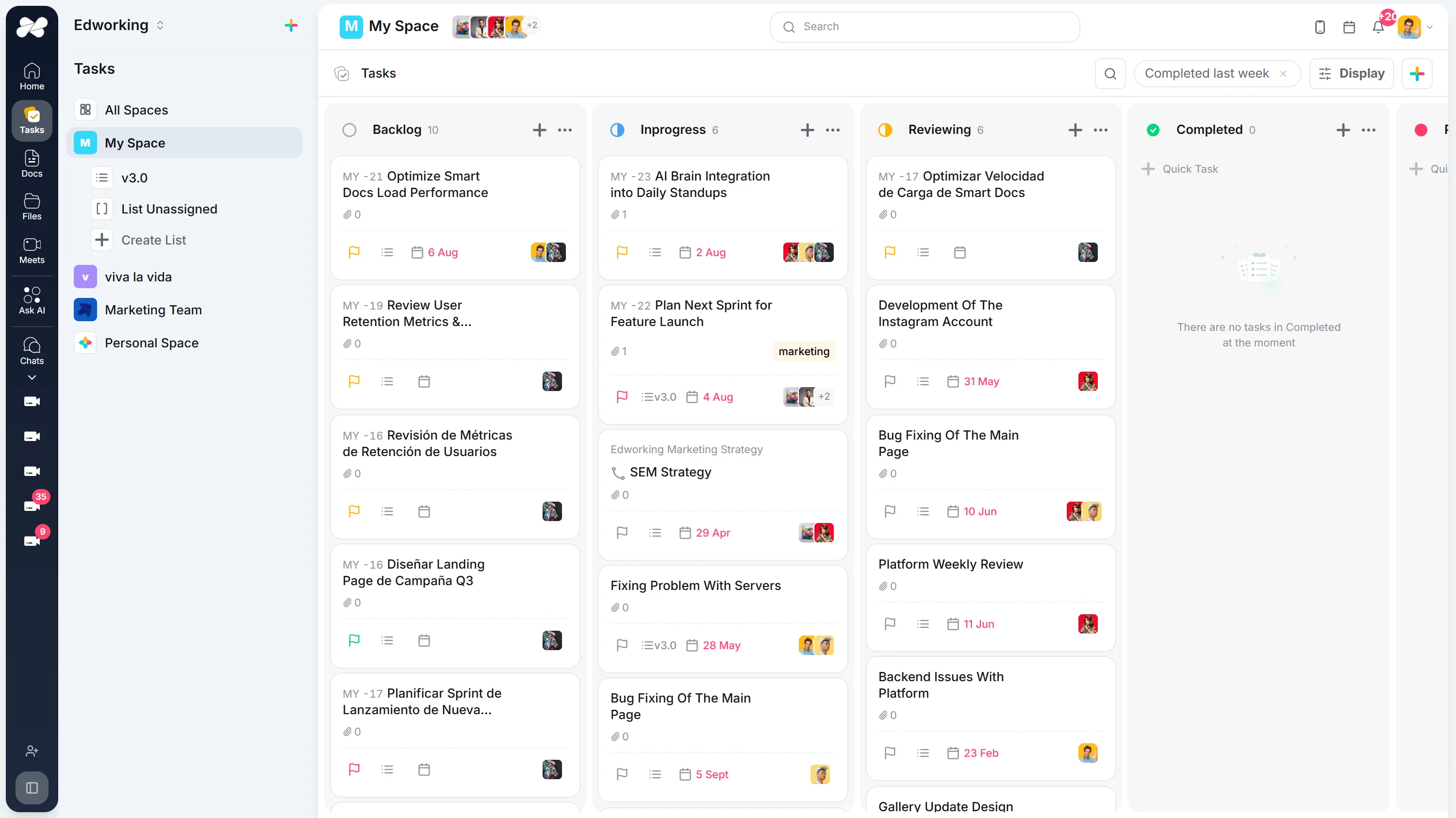
Opens the full interactive demo with an example workspace in English.
Frequently Asked Questions
A startup focuses on rapid growth and scalability, often seeking venture capital and aiming to disrupt markets. A small business typically aims for steady, sustainable growth and profitability without necessarily scaling to a massive size.
It varies greatly depending on your industry and business model. Some tech startups can launch with minimal capital through bootstrapping, while others may need significant funding. Many successful startups started with less than $10,000.
Consider going full-time when you have validated your idea, have some initial traction or revenue, and have enough runway (savings or funding) to support yourself for at least 12-18 months.
Not always, but having technical expertise on your founding team is crucial for tech startups. If you're not technical, consider finding a technical co-founder, hiring a CTO, or using no-code tools to build your MVP.
Ideas alone are rarely valuable—execution matters more. Focus on building quickly and iterating. Use NDAs sparingly (most investors won't sign them). Consider patents or trademarks only when you have something concrete to protect.