Download Mobile App
 Why startup priorities feel harder than normal task planning
Startup teams rarely lose momentum because they have no ideas. They lose momentum because every idea sounds urgent at the same time. A customer asks for a feature, an investor wants a metric update, the team complains about a broken handoff, and growth experiments keep piling up in the backlog. Without a simple way to compare those requests, the loudest item often wins instead of the most important one.
Quick takeaway: a startup priority scorecard gives founders a repeatable way to compare work by impact, urgency, confidence, revenue connection, and effort before turning it into tasks.
The goal is not to make prioritization mechanical. Founders still need judgment, context, and a clear strategy. The scorecard simply makes that judgment visible so the team can understand why one initiative moves now, why another needs more evidence, and why a distracting request should be parked for later. This is especially useful for small teams using an all-in-one workspace such as Edworking because the decision should not live in a spreadsheet that nobody opens again.
The five factors that make a priority worth doing
A useful scorecard needs a small number of factors that capture both upside and execution reality. Too many criteria slow the team down. Too few criteria hide important tradeoffs. For startup planning, five factors are usually enough.
- Impact: how much the work can improve customer value, team speed, risk reduction, or growth.
- Urgency: how quickly the team needs to act before the opportunity loses value.
- Confidence: how much evidence supports the idea from customers, data, team feedback, or recent work.
- Revenue connection: how directly the work supports acquisition, activation, retention, expansion, or cost control.
- Effort: how much capacity, coordination, uncertainty, or dependency load the work requires.
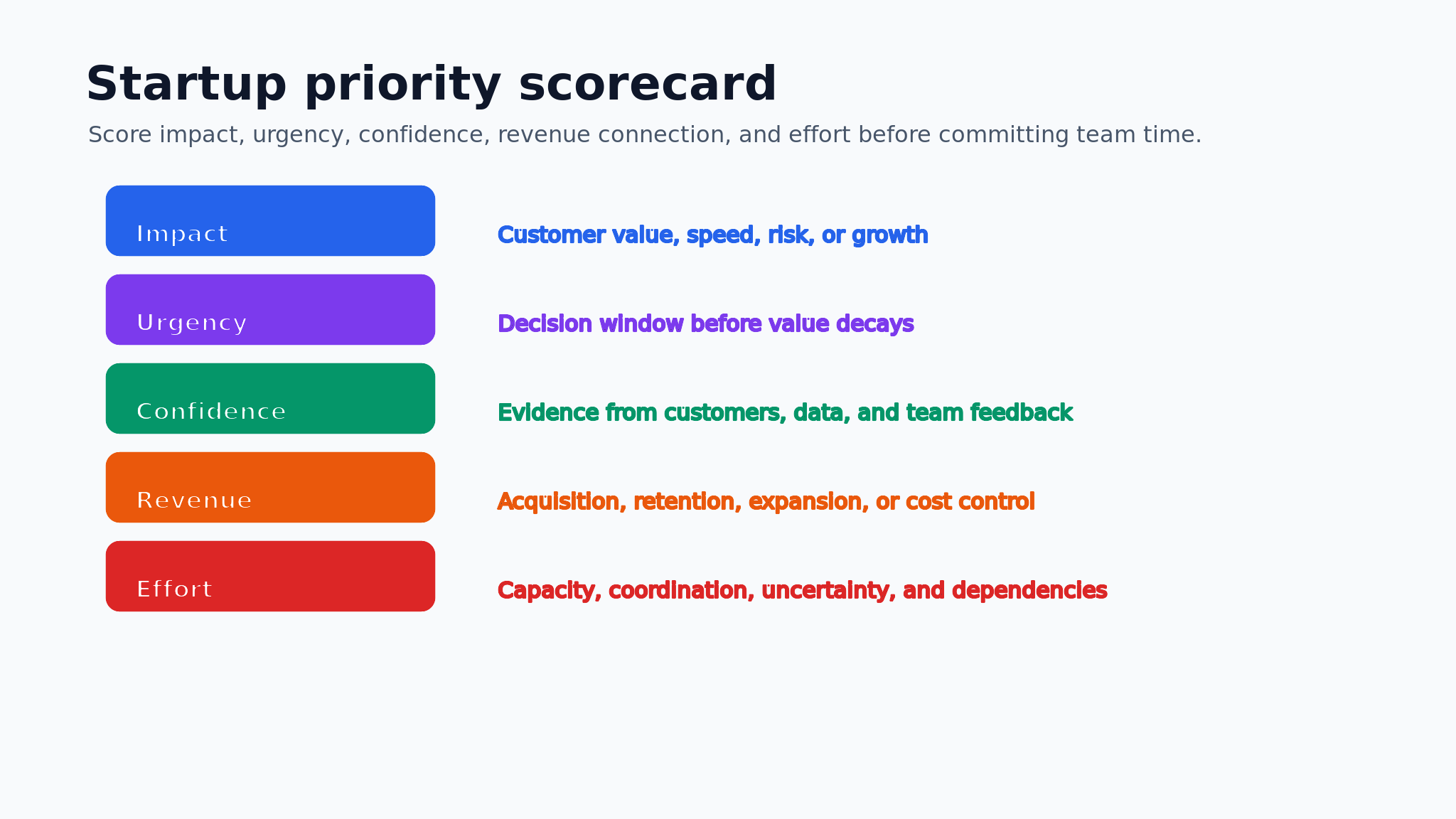
Impact and urgency prevent the team from treating every task as equal. Confidence keeps the team honest about whether the idea is supported by real evidence. Revenue connection forces a startup to ask whether the work helps the business survive and grow. Effort protects the team from committing to work that looks attractive but will quietly consume a month of focus.
A simple scoring table for founders
Use the same scale for each factor. A score of 1 means weak, unclear, or low-value. A score of 5 means strong, obvious, or high-value. For effort, the meaning is inverted in the final score because high effort should reduce priority unless the upside is clearly worth it.
- Impact 1: cosmetic improvement or internal preference; Impact 5: meaningful customer, revenue, speed, or risk outcome.
- Urgency 1: can safely wait; Urgency 5: delay would lose a customer, deadline, learning window, or market opportunity.
- Confidence 1: mostly opinion; Confidence 5: backed by customer proof, data, repeated team signal, or clear operational pain.
- Revenue connection 1: no clear business path; Revenue 5: directly tied to acquisition, activation, retention, expansion, or cost reduction.
- Effort 1: small and low-risk; Effort 5: cross-functional, uncertain, or dependency-heavy.
Decision rule: do not let a high-impact score hide low confidence. If the evidence is weak, shape a smaller test before committing the whole team.
How to interpret the result
The scorecard should produce three practical outcomes: do now, shape first, or park it. These categories are more useful than a raw number because they tell the team what action comes next. A 90-point initiative should become owned work. A 60-point idea probably needs a brief, a smaller experiment, or clearer evidence. A 35-point request should not sit in the active backlog creating guilt.
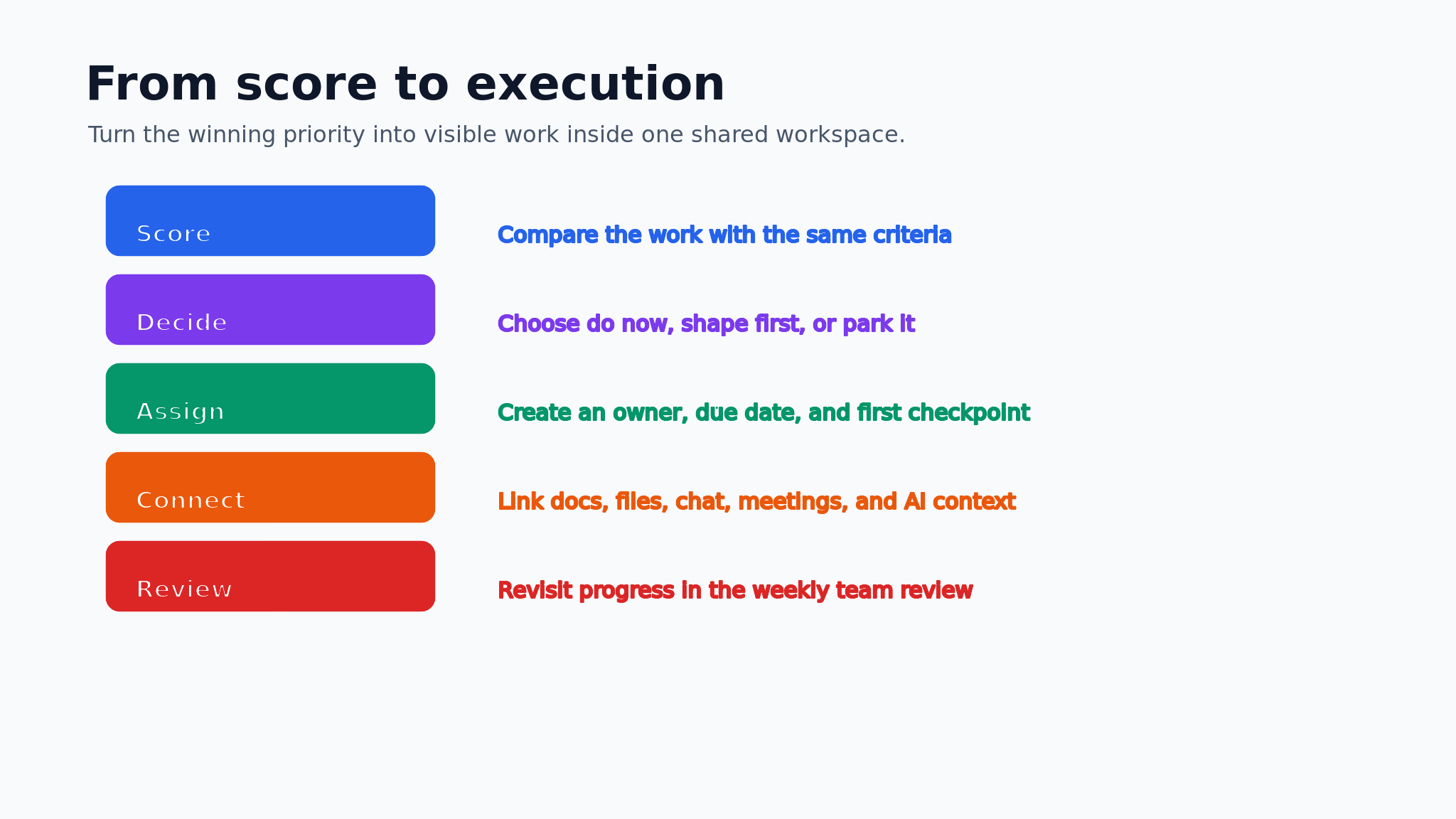
- Do now: assign one owner, define the first checkpoint, and connect the work to a measurable outcome.
- Shape first: write a one-page brief, collect missing evidence, or reduce the scope into a smaller test.
- Park it: save the context, define the trigger for revisiting, and remove it from active planning.
This is where Edworking helps. A founder can create a doc for the scorecard, turn the chosen priority into tasks, attach supporting files, discuss tradeoffs in chat, use meetings only when a live decision is needed, and later ask AI to surface the original context. The score becomes part of the workflow rather than a forgotten planning artifact.
Practical example: choosing between three startup initiatives
Imagine a startup is choosing between a new reporting dashboard, a pricing-page rewrite, and a cleanup of internal handoffs. All three sound useful, but they solve different problems. The reporting dashboard might have high effort and medium revenue connection. The pricing rewrite might have direct acquisition impact and strong evidence from sales calls. The internal handoff cleanup might reduce wasted time but lack urgency.
Example: if the pricing-page rewrite scores 4 impact, 4 urgency, 4 confidence, 5 revenue connection, and 2 effort, it should probably move now. If the dashboard scores 5 impact but only 2 confidence and 5 effort, shape it into a smaller research task first.
The value of the exercise is the conversation it creates. The team can see why one initiative deserves immediate attention and why another needs more evidence. That makes tradeoffs easier to accept and reduces the chance that a parked idea keeps returning every planning meeting.
Checklist for turning a score into action
Scoring is only useful if the result changes execution. After the team chooses a priority, move it into a visible operating rhythm.
- Create one owner, not a vague shared responsibility.
- Add a due date or checkpoint date, even for discovery work.
- Link the decision doc, supporting customer notes, files, or metrics.
- Define the first measurable signal, not a broad success statement.
- Decide where progress will be reviewed: weekly team review, sprint planning, or founder sync.
- Park rejected ideas with a revisit trigger so they do not clutter active work.
Small teams should keep this lightweight. The scorecard should make decisions faster, not create another approval layer. If scoring takes more than ten minutes for a normal priority, the process is too heavy.
Common mistakes to avoid
The most common mistake is treating the score as a substitute for strategy. A high number does not mean the work fits the company direction. It only means the work looks strong against the factors you selected. Founders still need to ask whether the priority supports the current stage of the business.
- Do not score every tiny task. Use the scorecard for meaningful ideas, tradeoffs, feature requests, operations fixes, and growth bets.
- Do not let effort disappear from the conversation. A high-upside idea can still be wrong if it blocks the team for weeks.
- Do not keep parked ideas in the active backlog. That creates noise and makes real priorities harder to see.
- Do not use different criteria every week. Consistency is what makes prioritization feel fair.
Edworking tip: keep one scorecard doc per planning cycle, then link accepted priorities to tasks and parked ideas to a future review note.
FAQs
Bring the decision back into the workspace
Use the scorecard as a practical conversation tool. Start with the current company goal, score only meaningful work, and keep the outcome connected to ownership. When a priority wins, create a task, link the planning document, attach files or customer notes, and define when the team will review progress. When a priority loses, park it with a revisit trigger so it does not keep distracting the team. This lightweight discipline helps founders protect focus while still leaving room for judgment, discovery, and fast changes when evidence improves.
Use the scorecard as a practical conversation tool. Start with the current company goal, score only meaningful work, and keep the outcome connected to ownership. When a priority wins, create a task, link the planning document, attach files or customer notes, and define when the team will review progress. When a priority loses, park it with a revisit trigger so it does not keep distracting the team. This lightweight discipline helps founders protect focus while still leaving room for judgment, discovery, and fast changes when evidence improves.
Use the scorecard as a practical conversation tool. Start with the current company goal, score only meaningful work, and keep the outcome connected to ownership. When a priority wins, create a task, link the planning document, attach files or customer notes, and define when the team will review progress. When a priority loses, park it with a revisit trigger so it does not keep distracting the team. This lightweight discipline helps founders protect focus while still leaving room for judgment, discovery, and fast changes when evidence improves.
Use the scorecard as a practical conversation tool. Start with the current company goal, score only meaningful work, and keep the outcome connected to ownership. When a priority wins, create a task, link the planning document, attach files or customer notes, and define when the team will review progress. When a priority loses, park it with a revisit trigger so it does not keep distracting the team. This lightweight discipline helps founders protect focus while still leaving room for judgment, discovery, and fast changes when evidence improves.
Use the scorecard as a practical conversation tool. Start with the current company goal, score only meaningful work, and keep the outcome connected to ownership. When a priority wins, create a task, link the planning document, attach files or customer notes, and define when the team will review progress. When a priority loses, park it with a revisit trigger so it does not keep distracting the team. This lightweight discipline helps founders protect focus while still leaving room for judgment, discovery, and fast changes when evidence improves.
Use the scorecard as a practical conversation tool. Start with the current company goal, score only meaningful work, and keep the outcome connected to ownership. When a priority wins, create a task, link the planning document, attach files or customer notes, and define when the team will review progress. When a priority loses, park it with a revisit trigger so it does not keep distracting the team. This lightweight discipline helps founders protect focus while still leaving room for judgment, discovery, and fast changes when evidence improves.
Prioritization should end with visible work. Once the team chooses what to do, move the priority into tasks, connect the planning doc, add the relevant files or customer notes, and schedule the review point. That is how a scorecard becomes execution instead of another planning exercise. Edworking is useful for this because tasks, docs, files, chat, video calls, and AI live in one workspace. The decision, owner, context, and follow-up can stay connected from the moment the team scores the idea to the moment the work is reviewed.