Download Mobile App



A startup priority scorecard makes competing requests easier to discuss. Use it when several ideas sound urgent but the team cannot do them all. The score should expose assumptions and tradeoffs; it should not replace a decision owner or a capacity check.
Start with one planning horizon
Choose a shared horizon, such as the next two weeks, and one outcome the team wants to improve. Comparing an emergency fix with a six-month expansion plan produces misleading rankings. Separate mandatory work and incidents before scoring discretionary ideas.
Write each candidate as an outcome rather than a vague activity. “Resolve the onboarding step blocking pilot customers” is easier to assess than “Improve onboarding.” Attach the evidence and name the person proposing the work.
A transparent scoring method
For this worksheet, rate five factors from 1 to 5. The calculation is a discussion heuristic, not a validated predictor of revenue or project success. Use the same definitions for every candidate in the review.
- Impact: 1 means a small improvement for a narrow audience; 3 means a meaningful improvement for the target group; 5 means a major effect on the agreed objective.
- Urgency: 1 means no meaningful near-term consequence from waiting; 3 means delay affects the next planning cycle; 5 means a documented deadline or current blocker makes waiting costly.
- Confidence: 1 means an untested assumption; 3 means some relevant evidence; 5 means strong, directly applicable evidence. Record the source, not just the rating.
- Commercial relevance: 1 means no clear connection to the current business objective; 3 means an indirect connection; 5 means a direct, evidenced connection. This is not a revenue forecast.
- Effort: 1 means the smallest complete item in the comparison; 3 means moderate work; 5 means the largest. Include review and follow-up, and split candidates that differ too much in size.
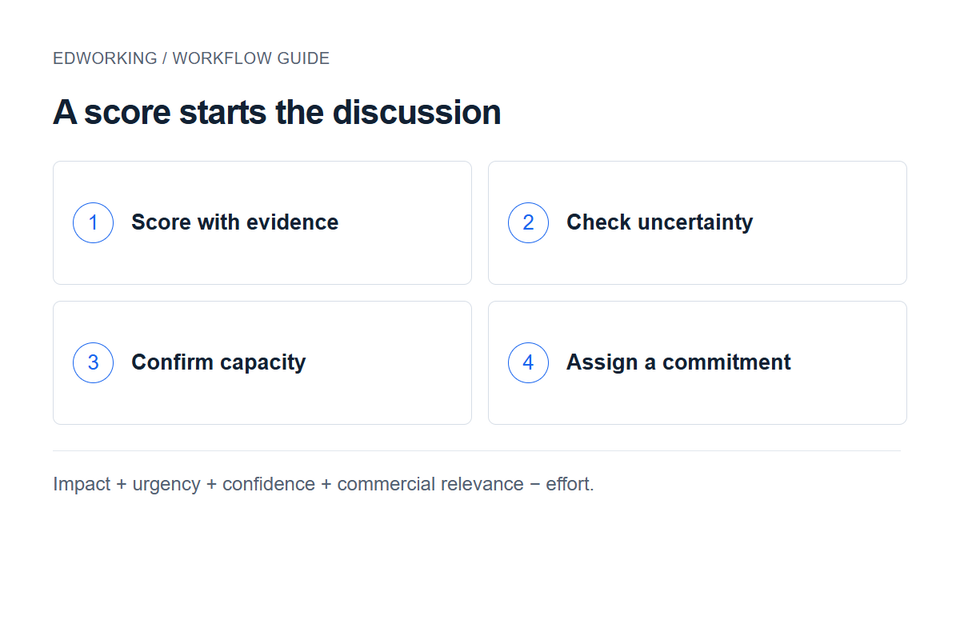
Use 2 and 4 for cases between the anchors. The net score is Impact + Urgency + Confidence + Commercial relevance − Effort. With these inputs, the range is −1 to 19. Higher scores move a candidate earlier in the discussion, not automatically into the plan.
Worked example
These are fictional ratings for a team comparing three items over the same two-week horizon. They illustrate the arithmetic rather than expected business results.
- Fix a blocked onboarding step: impact 4, urgency 4, confidence 4, commercial relevance 5, effort 2. Score: 4 + 4 + 4 + 5 − 2 = 15.
- Test new homepage messaging: impact 3, urgency 2, confidence 2, commercial relevance 3, effort 2. Score: 3 + 2 + 2 + 3 − 2 = 8.
- Redesign an internal report: impact 2, urgency 1, confidence 4, commercial relevance 1, effort 3. Score: 2 + 1 + 4 + 1 − 3 = 5.
The onboarding fix deserves attention first because its evidence and current blocking effect are clearer. The messaging idea needs a small test before a large commitment. The report may wait unless a required stakeholder need changes the assessment.

Check what the number can hide
Impact and commercial relevance can overlap. If the same evidence is doing all the work in both ratings, reduce the weight of one or remove it for that review. Do not change the formula halfway through comparing candidates.
Low confidence is a reason to design a smaller learning step, even if the total is attractive. A legal obligation, security incident or contractual commitment should follow its own required process rather than competing as an optional idea. Dependencies can also make a lower-scoring task necessary first.
For a simpler way to distinguish essential work from optional work, compare the MoSCoW prioritization method. Pick one method for the decision instead of combining several scores without a clear rule.
Turn the ranking into a feasible plan
Choose the highest-value work that fits the team's actual capacity. A ranked list of ten items is not a commitment to complete all ten. For each accepted item, name an owner, write the acceptance condition and record what will wait.
Keep the reason in a decision log. If a task depends on another team's input, record that dependency before assigning a deadline. The team dependency map provides a practical structure.
A short review routine
- Before the review, ask each proposer to supply evidence and an effort estimate.
- During the review, discuss rating differences and unresolved assumptions.
- Select only the work that fits available capacity, and record the deferred items.
- At the next review, compare what you learned with the original assumptions. Change ratings when evidence changes, not merely because someone repeats the request.
You can keep the scorecard in a shared document and link accepted items to tasks in Edworking. The useful result is a small set of owned commitments with visible reasoning, rather than a large backlog decorated with unexplained numbers.